
Free online autism test (AQ-10) with instant results
Use our online autism screening test to identify whether you or your child may benefit from a diagnostic assessment for autism.

Take our free AQ-10 autism screening test for yourself or your child. Instant results, no sign-up needed, and it's the same questionnaire the NHS uses.
We offer a free online screening test for autism, known as the autism spectrum quotient (AQ-10). It's a user-friendly questionnaire that indicates whether you/your child might benefit from receiving a full diagnostic assessment for autism. This can be a useful step if you’re not sure whether you/your child might be showing autistic traits, or if you just want some confirmation of the traits you’ve observed.
You can fill in the AQ-10 on behalf of yourself or a child/young person. It's quick to complete, and you'll get your results immediately.
The AQ-10 was developed by The Autism Research Centre at The University of Cambridge, and it is recommended to be used as an autism screening tool by the National Institute for Health and Care Excellence (NICE).
The AQ-10 is a self-report questionnaire and has three different versions:
Autism test for adults – designed for people over the age of 16, to complete for themselves
Autism test for children – designed for children between the ages of 4 and 11, to be completed by their parents/carers
Autism test for teens/adolescents – designed for young people between the ages of 12 and 15, to be completed by their parents/carers
The test contains 10 statements and you’ll be asked to rate the extent to which you agree with each of the statements, using a 4-point rating scale.
Once you’ve rated each of the statements, these will be automatically scored and you’ll receive some information on what the results mean.
To access and complete the AQ-10, follow these simple steps:
Select the version of the AQ-10 that’s the most appropriate for your needs
Complete the test, rating each statement honestly, based on recent observations of yourself or your child
Once you’ve completed all of the statements, your responses will be automatically submitted and scored
You’ll receive immediate feedback, providing you with insights into whether you/your child may be showing neurodivergent traits

The AQ-10 is a short, 10-question autism screening test. It's an abbreviated version of the Autism Spectrum Quotient (AQ), the questionnaire developed by Professor Simon Baron-Cohen and colleagues at the Autism Research Centre at the University of Cambridge. The AQ-10 was designed to give a quick, reliable indication of whether someone is showing autistic traits and might benefit from a full diagnostic assessment. It takes a couple of minutes to complete, and you'll get your result straight away.
Not all online autism tests are the same. Many are unvalidated quizzes with no clinical grounding. The AQ-10 is different: it's the screening tool recommended by the National Institute for Health and Care Excellence (NICE) for identifying adults who may benefit from a full autism assessment. That's why the same questionnaire is used across the NHS and by private providers, including as the first step in our own autism assessments. Using the AQ-10 means the test you take here is the same recognised screening tool a professional would use, rather than a general quiz.
You may also come across the AQ-50, sometimes just called "the AQ". This is the original, longer 50-question version. It gives a fuller measure of autistic traits and is often used for research, but it takes longer to complete. The AQ-10 was created as a shorter screening version for everyday clinical use, which is why it's the one NICE recommends and the one we offer here. For a first step, the AQ-10 gives you a quick, evidence-based indication without needing to work through all 50 questions.
The AQ-10 gives you a score out of 10. Each of the 10 statements is scored as either 0 or 1, depending on how strongly you agree or disagree, and these are added together. As a general guide, a score of 6 or more suggests it may be worth considering a referral for a full autism assessment. A lower score suggests fewer autistic traits are showing at the moment, but it doesn't rule autism out, particularly if the traits that prompted you to take the test are affecting daily life. The result is an indication, not a diagnosis, and it's best understood alongside your own history and experiences.
Here’s a breakdown of what these scores suggest, for adults, children and adolescents:
Score | What does this suggest? |
|---|---|
Below 6 | You/your child are showing little to no autistic tendencies. |
Above 6 | You/your child may be experiencing some of the common signs and characteristics of autism. |
It’s important to understand that a score of below 6 doesn’t mean that the person definitely isn’t autistic; it just means they’re not currently showing any of the core signs of autism.
On the other hand, a score of above 6 doesn’t equal a diagnosis of autism; it just indicates that this could be a possibility for the person and they might benefit from further assessment.
While screening tests like the AQ-10 can provide valuable insights, they’re just one piece of the puzzle. It's important to interpret these results within the broader context of a person’s history, experiences and additional assessments. Autism is a complex neurodevelopmental condition, and a comprehensive evaluation takes into account lots of different factors to ensure accurate diagnosis and appropriate support - Debbie Longsdale, Therapy Director
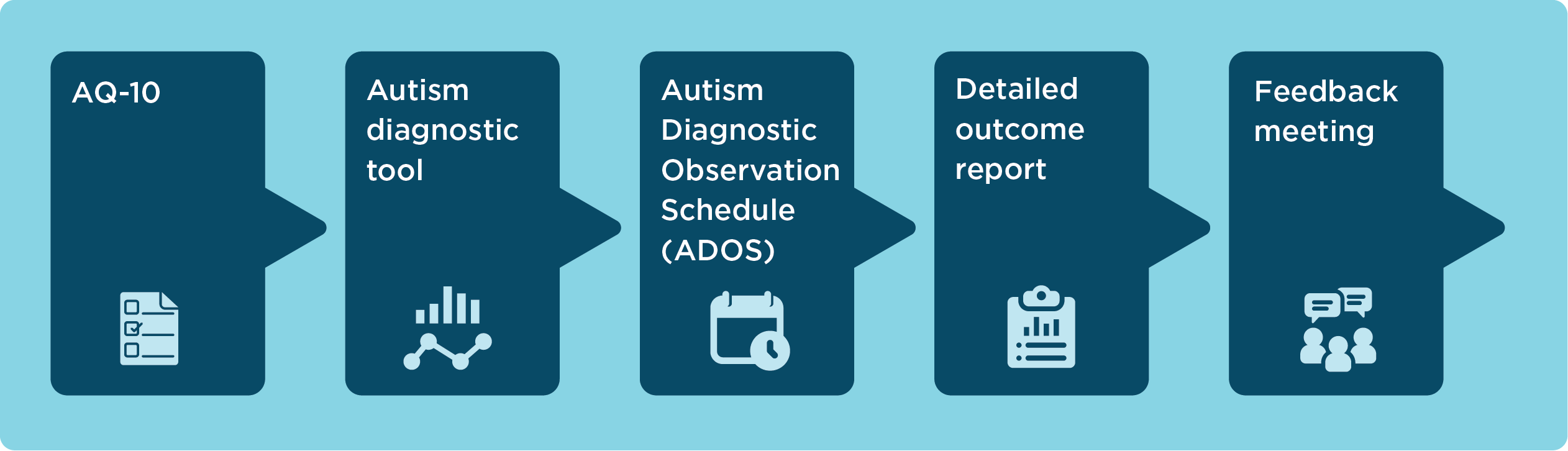
For more information on this process, please visit our dedicated autism assessments page.
As well as reaching out for a specialist autism assessment, there are a number of charities and organisations throughout the UK that can provide support for autistic adults and young people.
These organisations offer a wealth of knowledge and understanding about autism, and can connect people and families with any additional support they need to navigate their autism journey effectively.
We are able to offer fast access private autism assessments and diagnosis to those who are showing signs of autism.
While online autism tests like the AQ-10 can provide valuable insights into potential signs of autism, it's important to recognise their limitations. Here are some factors to consider:
However, while the AQ-10 does have the above limitations, it’s also grounded in lots of research on the characteristics and behaviours commonly seen in autistic people. Therefore, this concise and accessible tool allows for efficient screening and identification of people who may benefit from further assessment and support.
Online autism tests can serve as valuable tools for raising awareness and prompting people to get a further evaluation. However, it’s also necessary to get a comprehensive assessment, conducted by qualified professionals, to confirm or rule out a diagnosis of autism. The AQ-10 can provide a starting point for discussion with healthcare providers, but it shouldn’t replace the expertise and clinical judgement of trained professionals - Debbie Longsdale, Therapy Director
Discover some frequently asked questions
If your results on the AQ-10 suggest that you or your child may be showing the signs of autism, it’s important to remember that this is simply a preliminary screening tool and not a diagnostic instrument. While a positive result may indicate that you or your child have some of the traits associated with autism, it doesn’t provide a definitive diagnosis.
However, a positive result could suggest that you or your child would benefit from a further evaluation by a qualified healthcare professional.
Research studies have shown promising results regarding the validity and reliability of the AQ-10 (source). However, while the AQ-10 can accurately identify people who may have characteristics commonly observed in autism, it’s not a diagnostic tool.
If you're considering an autism assessment, there are several avenues you can explore to find a qualified healthcare professional:
It's worth knowing that screening tools like the AQ-10 can be less reliable for women and girls. Autism often presents differently in women and girls, and many learn to mask or camouflage their traits, which means a lower score doesn't necessarily rule autism out. If you're a woman or girl, or completing the test on behalf of one, and the result doesn't match what you're experiencing day to day, it can still be worth exploring further. Our guide to autism in girls covers how traits can show up differently and what to look out for.